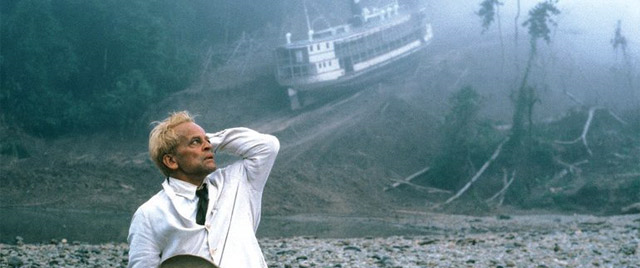
Werner Herzog, Fitzcarraldo (1982)
Fitzcarraldo: Au cuisinier de vos chiens! À Verdi! À Rossini! À Caruso!
Don Araujo: À Fitzcarraldo, le conquérant de l'inutile!
Fitzcarraldo: Aussi vrai que je me tiens devant vous, j'apporterai un jour un grand opéra dans la forêt vierge! Je suis…dans le surnombre! Je suis les milliards! Je suis le spectacle dans la forêt! Je suis le découvreur de caoutchouc! Grâce à moi seul, le caoutchouc est Verbe!
L'homme est une passion inutile.
–Jean-Paul Sartre, L'être et le néant
D'un espace inutile
J’ai plusieurs fois essayé de penser à un appartement dans lequel il y aurait une pièce inutile, absolument et délibérément inutile. Ça n’aurait pas été un débarras, ça n’aurait pas été une chambre supplémentaire, ni un couloir, ni un cagibi, ni un recoin. Ç’aurait été un espace sans fonction. Ça n’aurait servi à rien, ça n’aurait renvoyé à rien.
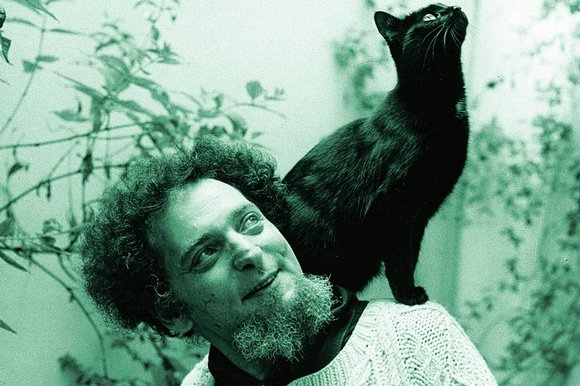
Il m’a été impossible, en dépit de mes efforts, de suivre cette pensée, cette image, jusqu’au bout. Le langage lui-même, me semble-t-il, s’est avéré inapte à décrire ce rien, ce vide, comme si l’on ne pouvait parler que de ce qui est plein, utile et fonctionnel.
Un espace sans fonction. Non pas « sans fonction précise », mais précisément sans fonction ; non pas pluri-fonctionnel, mais a-fonctionnel. Ça n’aurait évidemment pas été un espace uniquement destiné à « libérer » les autres (fourre-tout, placard, penderie, rangement, etc.) mais un espace, je le répète, qui n’aurait servi à rien.
–Georges Perec, Espèces d'espaces
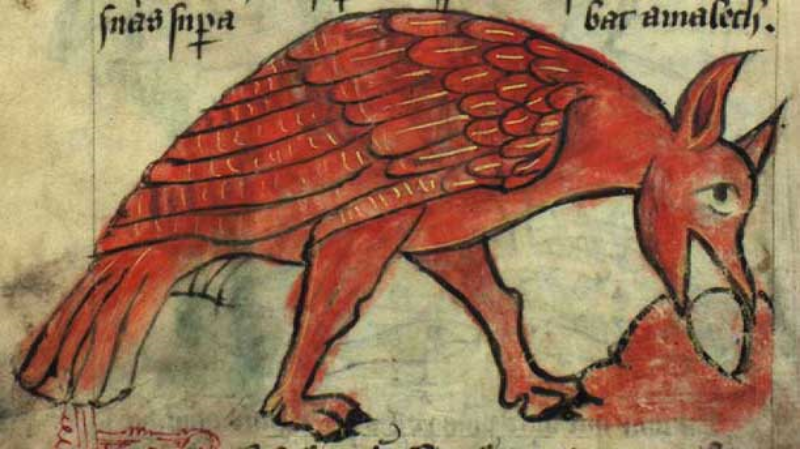
Bestiary of Ann Walsh (England, 15th century)
Some say the word “Odradek” descends from the Slavic, and they account for the word’s formation on that basis. Others believe it descends from the German and has only been influenced by Slavic. The uncertainty of both interpretations suggests, probably correctly, that neither of them is accurate, particularly since one cannot find a meaning of the word in either of them.
Of course no one would be concerned with such investigations were there not an actual entity called Odradek. It looks at first like a flat, star-shaped spool of thread, and indeed it seems to be covered in thread; these threads however could only be tattered, old pieces of the most disparate kind and color, knotted together but also tangled up in one another. But it is not just a spool: from the middle of the star emerges a small diagonal rod, and joined to this rod at a right angle is another one. With help from this second rod on one side and one of the star’s emanations on the other side, the whole thing can stand upright as if on two legs.
One might be tempted to believe that this figure once had some purposeful form and is now simply broken. But this does not seem to be the case; or at least there is no indication thereof; nowhere can edges or breakages be seen that would suggest something of the kind; the whole thing appears rather senseless and yet complete in its own way. There is, incidentally, nothing more to say about it, since Odradek is extraordinarily mobile and not to be caught.
He resides alternately in the attic, the stairwell, the passageways, the hall. Sometimes he is out of sight for months, likely having moved into other houses; but to our house inevitably he returns. Sometimes, upon walking out the door to find him just then leaning on the banister below, one is inclined to speak to him. Of course one doesn’t ask him difficult questions but rather handles him – duped by his tininess – like a child. “What’s your name?” one asks. “Odradek,” he says. “And where do you live?” “No fixed abode,” he says and laughs, but it’s only the kind of laugh that can be produced without lungs. It sounds something like the rustling of fallen leaves. And that is usually the end of the conversation. Incidentally, even these answers are not always to be had; often he is mute for a long time, like the wood that he appears to be.
In vain I ask myself what will become of him. Can he die? Everything that dies once had a kind of purpose, a kind of function and that is what has ground it down; this is not true of Odradek. Will he one day rumble down the stairs, a strand of thread dragging behind him, before the feet of my children and my children’s children? Clearly he is hurting no one; but the notion that he will outlive me is an almost painful one.
–Franz Kafka, "The Father's Concern" (Trans. Lisa Marie Anderson)
Gavest Thou the goodly wings unto the peacocks? or wings and feathers unto the ostrich? Which leaveth her eggs in the earth, and warmeth them in dust, and forgetteth that the foot may crush them, or that the wild beast may break them. She is hardened against her young ones, as though they were not hers: her labour is in vain without fear; Because God hath deprived her of wisdom, neither hath he imparted her understanding. What time she lifteth up herself on high, she scorneth the horse and his rider.
–Job 39:13-18 (KJV)
On sent bien que l'autruche n'avait aucun besoin de la fourchette ou de cet os en forme de V, destiné à prévenir le rapprochement des deux ailes dans les violens mouvemens qu'elles exécutent. Cependant cet os existe; mais divisé vers le bas il est sans usage : chacune de ses branches se trouve soudée par son extrémité antérieure avec l'os déjà composé de la clavicule et de l'omoplate.
(Quoiqu'inutiles dans cette circonstance, ces rudimens de fourchette n'ont pas été supprimés, parce que la nature ne marche jamais par sauts rapides, et qu'elle laisse toujours des vestiges d'un organe, lors même qu'il est tout-à-fait superflu, si cet organe a joué un rôle important dans les autres espèces de la même famille...)
–Geoffroy Saint-Hilaire, "Observations sur l'aile de l'Autruche, par le citoyen Geoffroy" (1798)
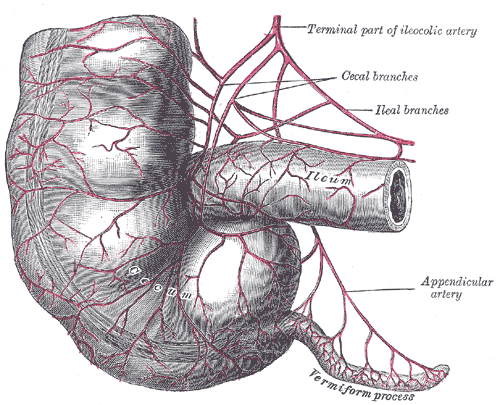
Henry Gray, Anatomy of the Human Body, Figure 1073
Les activités humaines sont innombrables et variées.
Certains détournent des avions, d'autres des fonds publiques, ou la conversation.
Je préfère, quant à moi, détourner de leur usage courant les objets usuels. C'est moins dangereux, plus honnête et infiniment plus divertissant!
Mes objets, parfaitement inutilisables, sont le contraire de ces gadgets dont notre société de consommation est si friande.
Si on me le demandait, je les qualifierais de poétiques, hilarants, absurdes, philosophiques, ingénieux, morbides, puérils, profonds, dérisoires...
Le lecteur serait alors prié, selon son humeur, ses goûts et sa culture, de biffer les qualificatifs inutiles.
–Jacques Carelman, Catalogue d'objets introuvables (1969)
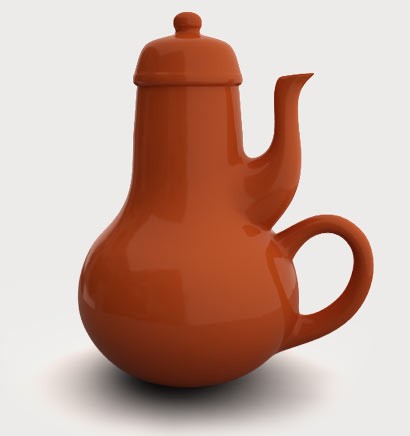
Jacques Carelman, "Cafetière pour masochiste"